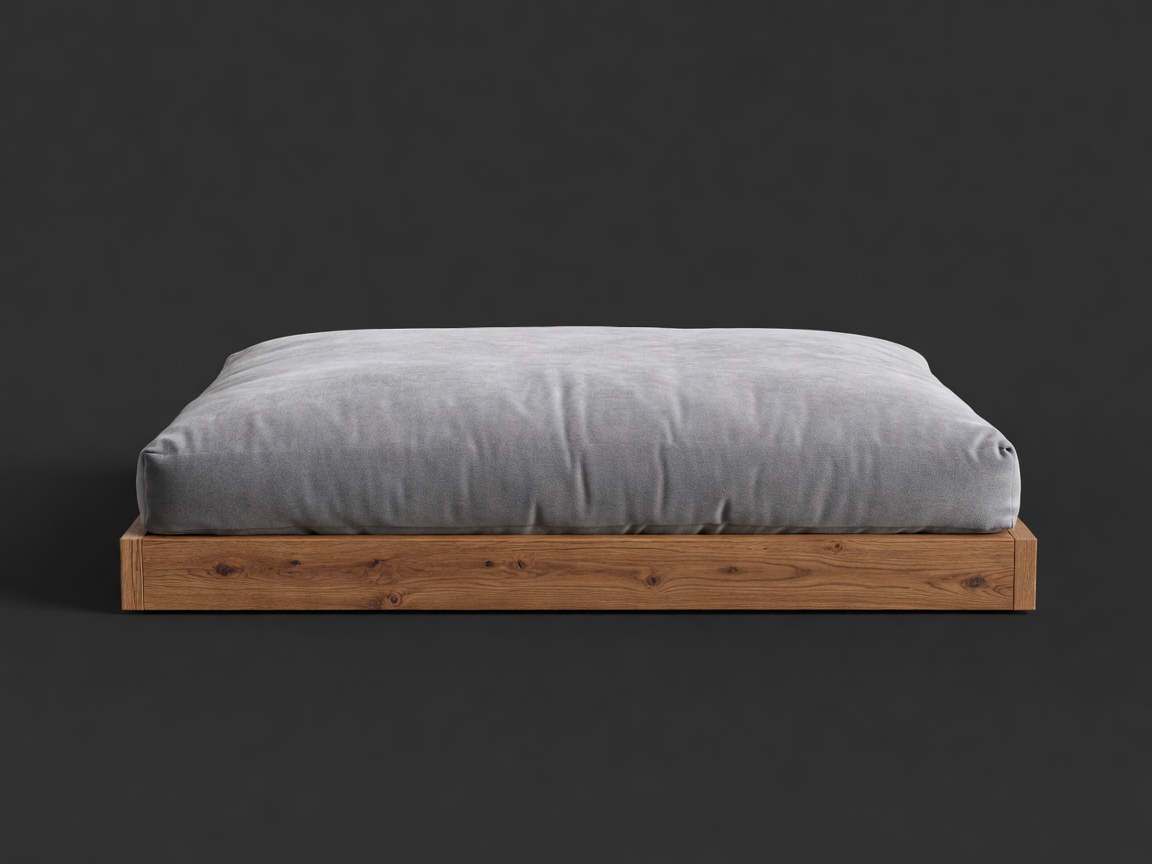
Observe before measuring
Watch several ordinary sleeping positions over a few days. A tightly curled shape tells only part of the story: many animals stretch, roll or sleep on their side when the room is quiet. Measure the occupied space in those relaxed positions without disturbing the animal. Use that information to discuss an internal sleeping area with the maker rather than selecting from the external dimensions alone.
Raised sides consume space. A bed that looks generous in plan may offer a surprisingly narrow cushion once its bolsters are included. Ask for both overall and usable measurements on the same drawing. Make a full-size paper outline on the floor and add temporary objects to represent the edges. This inexpensive test also reveals whether the bed obstructs a doorway or a preferred walking route.
Make entry an ordinary movement
A handsome platform is not automatically a comfortable entrance. Consider the height from the finished floor to the compressed sleeping surface, the firmness of the front edge and whether the base slides during entry. Smooth floors may require a compatible non-slip underside, but pads should be checked for staining or marks on the actual flooring. A heavy frame should still be movable for cleaning.
For an older animal, one recovering from surgery or any pet with difficulty moving, obtain veterinary advice before deciding on height or support. A furniture description such as “orthopaedic” does not establish a medical benefit. Ask what the cushion contains, how it behaves under the animal’s weight and whether the filling can be replaced independently of the frame. Avoid promising that a particular foam will treat a condition.
Separate the upholstery system
Think of the bed as a set of serviceable layers: frame, cushion core, protective liner and outer cover. Each layer should have a clear purpose. A liner may help keep occasional moisture away from the filling, but it does not eliminate the need to inspect and dry the cushion. Ask whether the liner is removable, how its seams are made and whether the complete assembly becomes noisy or warm in use.
A removable cover is useful only if removal is practical. Check the opening size, zip position and whether the fabric must be stretched aggressively over the core. Request washing and drying instructions for the exact finished cover, including any shrinkage allowance. A spare cover can make a meaningful difference when laundry takes a day to dry. Conceal fasteners from chewing and inspect them regularly.
Specify details that age well
Timber edges should be smooth to the touch, with no exposed fixings where an animal lies or rubs. Upholstered corners should avoid loose decorative loops and accessible trims. Deep buttoning and elaborate piping can collect hair, while a simple seam may be easier to vacuum. These are maintenance trade-offs rather than a rule that all detail is undesirable. Ask the maker to show how a chosen seam will be cleaned.
Keep replacement information with the order: fabric reference, colour, cushion dimensions, filling description and hardware details. A named textile from Kvadrat or Gabriel still needs a care specification for the assembled bed; the fabric brand alone cannot describe the full product. Request a small offcut for future repair matching, and agree whether the maker can supply a replacement core without rebuilding the frame.
Test acceptance, not just appearance
Place the new bed near a familiar resting location and allow the animal to investigate without pressure. An unfamiliar smell, a warmer surface or a less sheltered position can matter more than the visual design. Retain an existing comfortable option during the transition. A successful commission supports the animal’s habits while bringing a quieter, more coherent object into the room.