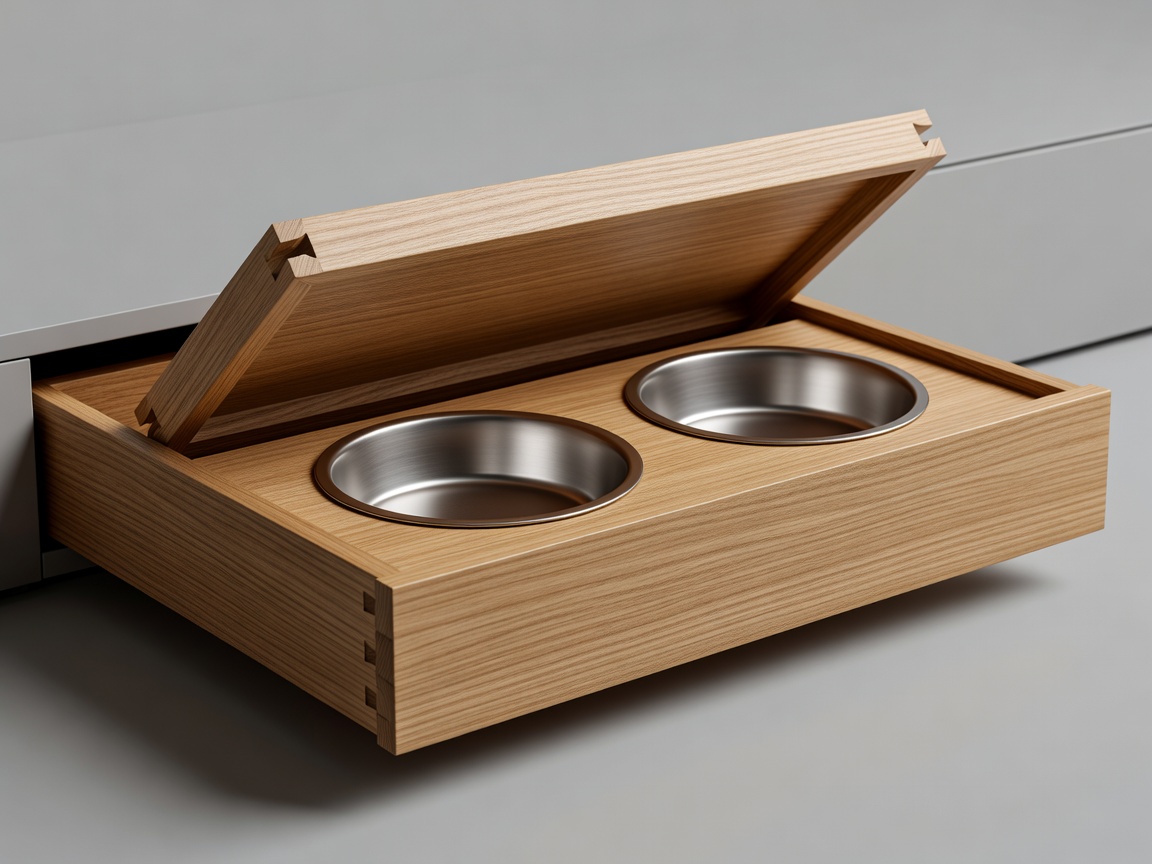
Choose a format around the routine
A permanent open niche makes bowls easy to reach but leaves the feeding area visible. A drawer can tidy away an empty meal station, yet its projecting front may become a trip point. A removable freestanding insert is less integrated but can be replaced without altering the cabinetry. Compare these arrangements against the actual room rather than assuming that the most concealed option is best.
Observe whether the animal moves bowls, splashes water or retreats from noise. Place feeding away from a busy doorway, a hot appliance or a cupboard opened repeatedly during meals. In a multi-animal household, one beautifully symmetrical pair of bowls may not meet the need for separate resources. Ask a veterinary professional for guidance where appetite, competition or posture creates a concern.
Design the wet area as a removable assembly
Water finds joints, screw holes and exposed board edges. A durable finish on the visible face does not protect an unsealed cut-out underneath a bowl. Specify a removable, washable spill tray with enough edge height for ordinary splashes, and make sure that the tray can be lifted without dismantling the cabinet. Inspect the surfaces below it regularly; trapped moisture can remain invisible.
Stainless steel, glazed ceramic and other bowl materials each need appropriate product information. Confirm that the actual bowls are intended for food contact and follow their manufacturer’s care instructions. Regulation (EC) No 1935/2004 provides the European framework for food-contact materials; it is not a blanket approval for any metal bowl. Check ceramic bowls for chips and stop using damaged items. Avoid specifying an irreplaceable bespoke bowl shape solely to achieve a flush fit.
Keep movement predictable
For a pull-out station, discuss the fully extended load, resistance to movement and the position of the drawer front around paws and feet. A runner’s headline load rating is only one part of the assembly. The maker must account for mounting, leverage and the intended use. Hardware from Blum, Hettich or Häfele should be selected by its exact specification, not by brand recognition alone.
Ask how the drawer stays in its intended position during feeding and how accidental closure is prevented. A soft-close action is not a substitute for examining pinch points. Do not let an animal use an unstable pull-out, and never treat a feeding drawer as a step. Where there is uncertainty about safe operation, a fixed open niche or freestanding station may be the more suitable design.
Do not make height a health claim
A raised bowl can look orderly within a cabinet elevation, but visual alignment does not determine the correct feeding position. The Royal Veterinary College and the British Veterinary Association are useful starting points for locating veterinary information; an individual recommendation still belongs with the animal’s own clinician. Do not assume elevation prevents digestive problems or is appropriate for every dog.
Use a temporary mock-up to examine practical access once any relevant clinical advice has been obtained. Check whether the head can move freely, whether the bowl rim is awkward and whether a deep recess forces the animal beneath an uncomfortable overhang. Cats may need a different location from dogs, and their preferences cannot be reduced to a scaled-down version of the same cabinetry detail.
Write the cleaning route into the drawing
Trace the journey from the filled bowl to washing, drying and replacement. Leave hand clearance to lift each bowl safely, including when the rim is wet. Avoid narrow grooves that require an improvised tool to remove food. Specify access to the rear of the recess and to the floor below the cabinet. Ventilation helps damp components dry, but it does not replace active cleaning.
At handover, ask for a demonstration with the actual bowls and tray, not an empty cabinet. Record replacement dimensions, runner information and finish care. A feeding station succeeds when its everyday maintenance is obvious and the animal can use it calmly. Concealment should remain an option, never the main measure of quality.